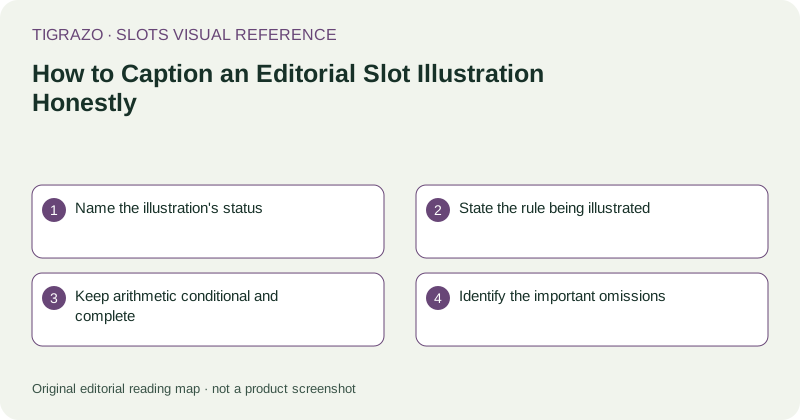
Name the illustration's status
Begin with an accurate category such as schematic, hypothetical arrangement or conceptual flow. Do not use screenshot when the image is an editorial construction. A realistic-looking frame makes this distinction more important, not less.
The caption need not apologise for illustration. A schematic can be excellent teaching material because it removes distraction. Its value comes from the clarity of its selected relationships, provided that selection is disclosed.
State the rule being illustrated
Identify the specific lesson: left-to-right qualification, horizontal and vertical adjacency, a multiplier base or a feature-entry condition. A caption that only says example win leaves readers without the rule needed to evaluate the picture.
Include the minimum condition that matters. If three consecutive matching symbols are required from the first reel, say that. If wild substitution is excluded from the example, make that limitation visible rather than allowing the picture to imply a universal rule.
Keep arithmetic conditional and complete
Hypothetical example: a caption may state that a 4-times modifier applied to a 0.75 qualifying award produces a 3.00 gross award. It should name both the base and the result. Calling 3.00 profit would require additional information about the cost and settlement convention.
Where no currency conversion is intended, keep values in clearly labelled credits. Do not allow a currency symbol in surrounding design to imply that every abstract unit is actual money.
Identify the important omissions
Most illustrations do not show symbol weighting, all possible outcomes, RTP configuration or event frequency. The caption should mention an omission when a reader might otherwise infer it. A crowded grid with many special symbols is especially vulnerable to being mistaken for a representative sample.
Never call an arrangement typical unless there is genuine evidence supporting that description. Likewise, an illustrated maximum award is not evidence of how often that award occurs or of the cost of pursuing it.
Make the final check from the reader's side
Read the caption without the article and ask what claims it appears to make. Could someone mistake it for firsthand testing? Could the arrows imply an inevitable sequence? Could the highlighted group be interpreted as a probability statement? Adjust the wording where needed.
- Is the example's hypothetical status explicit?
- Is the relevant rule named?
- Are all numerical units clear?
- Are major inference risks addressed?
- Does the caption avoid invented experience?
An honest caption does not need to be long. It needs to establish what the illustration demonstrates, what assumptions make it work and what conclusions cannot be drawn from the selected picture.