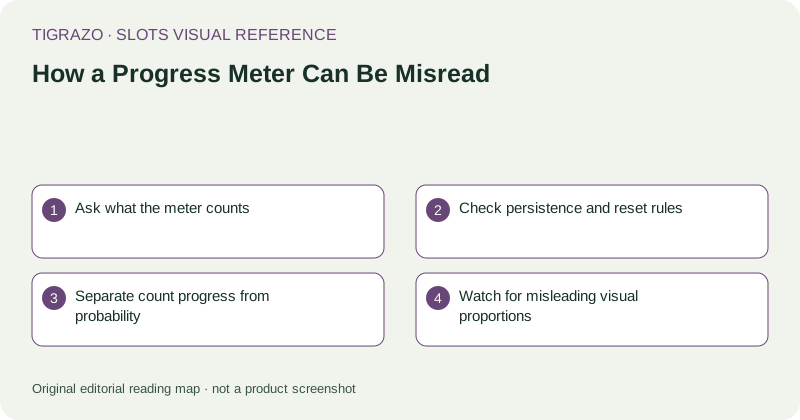
Ask what the meter counts
Begin with the quantity represented: collected items, completed actions, accumulated award or another defined state. A bar with no unit can create a strong impression of progress while leaving its actual meaning unclear. The caption should name the count and its scope.
Do not infer the meaning from artwork. A nearly open door might represent a documented threshold, but it might also be a visual transition. Narrative readiness is not the same as a mathematical condition.
Check persistence and reset rules
Determine whether the state carries between rounds, remains only within a feature or resets under specified circumstances. If persistence depends on a mode, account state or other condition, that qualification belongs beside the meter explanation.
A useful schematic shows at least one reset point. Without it, readers may assume that all visible progress remains available indefinitely. A diagram should not make an unverified promise about what survives closing a window or changing configuration.
Separate count progress from probability
Hypothetical example: a rule awards a feature after ten collected tokens, and the meter shows seven. Three additional tokens are required under that rule. This does not establish how many paid rounds will produce those tokens, what they will cost or what the feature will award.
If the rules instead state that each round has an independent random trigger and the meter is decorative, its visual fullness supplies no evidence that the next trigger is closer. These two situations require very different captions.
Watch for misleading visual proportions
A bar that appears 90% full may not represent a 90% completion measure. Segments may be uneven, labels may be absent, or the display may use a nonlinear animation. Read the stated numeric count when one exists instead of estimating from coloured area.
Even a genuinely linear count should not be redrawn as a probability gauge. Completing nine of ten collection steps is not automatically a 90% chance of receiving an award on the next round.
Write an honest interpretation
Describe only what the rules support: the current recorded count, the threshold if any, persistence conditions and the event that advances or resets it. Add a clear unknown where the interface does not establish a relationship.
- What is counted?
- What carries forward?
- What resets?
- Does the rule link this state to a trigger?
- Is any claimed probability actually documented?
A meter can be informative without becoming a reason to continue. Apparent incompleteness does not create an obligation, and a near-finished picture should not displace a previously chosen time or spending boundary.