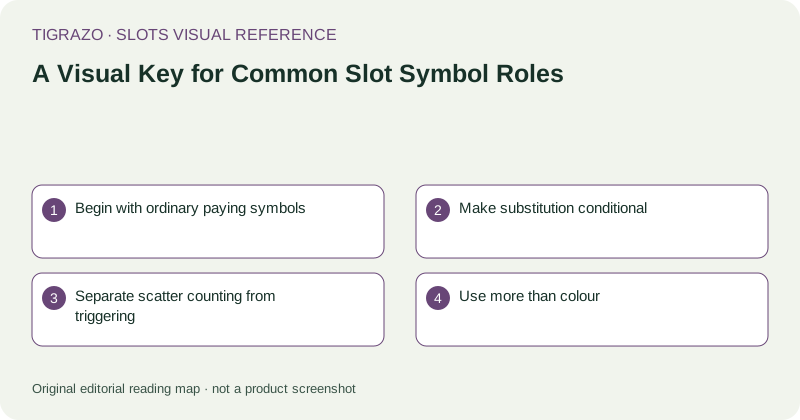
Begin with ordinary paying symbols
Give regular symbols a neutral category before introducing special ones. Their usual role is to contribute to awards under the game's stated matching rules. Their relative illustrated size or narrative importance does not necessarily establish their paytable value.
A useful key names the symbol and its function without requiring a specific artistic design. Labels such as regular symbol A can support an editorial schematic without pretending to reproduce an actual game's inventory.
Make substitution conditional
A wild commonly substitutes for certain symbols, but the permitted set and restrictions must come from the rules. Some wilds apply only on particular reels or in certain states. Others may carry modifiers or fail to substitute for scatters and jackpot symbols.
Represent those limits in words next to the symbol. An all-purpose arrow pointing from wild to every other icon would suggest a universal power that may not exist. Clear exclusions often matter more than a dramatic special-symbol badge.
Separate scatter counting from triggering
A scatter may count independently of paylines, but this does not mean every scattered arrangement produces an award. The minimum count, allowed locations and relevant game state remain important. A scatter can also have a feature-entry role, which should be listed separately.
Hypothetical example: three marked symbols anywhere trigger a feature, while a separate paytable requires four for a direct scatter award. A three-symbol illustration should therefore show entry without falsely displaying a direct cash award.
Use more than colour
Distinguish roles with labels, outlines or simple shape conventions as well as colour. Readers may view the key in monochrome, at small size or with reduced colour discrimination. A legend that relies on red versus green alone can lose its entire meaning.
Keep decorative artwork visually subordinate to the functional labels. If the icon is too elaborate to recognise at its displayed size, use a simplified schematic token and explain that it is an editorial representation rather than a captured game asset.
Check the key against one example
Walk through a sample arrangement and ask whether the legend supplies every necessary distinction. Does it explain why a wild completes one match but not another? Does it show whether a trigger is also a paying symbol? Missing answers reveal where the key needs revision.
- Name the role, not only the picture.
- State the rule's scope.
- List important exclusions.
- Distinguish direct awards from feature entry.
- Label hypothetical tokens clearly.
The finished key should support accurate reading without suggesting that symbol frequency can be inferred from icon size, colour or prominence. Visual hierarchy is a teaching device, not evidence of the game's underlying probability distribution.