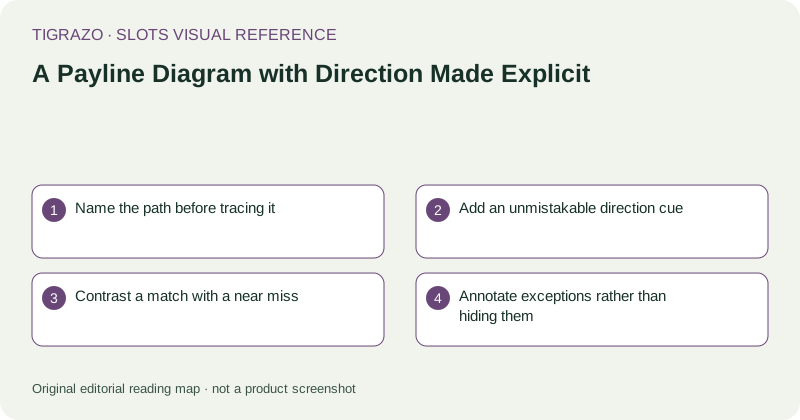
Name the path before tracing it
A payline identifies a sequence of positions across reels. It may be straight, angled or irregular. The illustration should distinguish that path from the symbols currently occupying it, because the same line can contain many different arrangements over successive rounds.
Use a neutral outline for the selected path and a separate mark for symbols that contribute to an illustrated award. Otherwise, readers may interpret every position touched by the line as automatically part of a win.
Add an unmistakable direction cue
If the stated rule pays left to right, show a labelled starting side and a clear reading arrow. If a rule pays in another direction or both directions, describe that explicitly. A geometric line by itself does not convey the award direction.
Keep the arrow separate from motion effects. An animated-looking sweep may imply the reels are being evaluated in that order, but decorative movement is less precise than a plain direction label attached to the schematic.
Contrast a match with a near miss
Hypothetical example: a five-reel line contains A, A, A, B, C from left to right. Under a rule requiring at least three consecutive matching symbols from reel one, the first three A symbols qualify. The B and C do not extend that match.
Now illustrate A, B, A, A, C on the same path. Only three A symbols appear, and they are not consecutive from the first reel. Under the stated rule, they do not qualify as that three-symbol line award.
Annotate exceptions rather than hiding them
If wild substitution matters, explain which marked wild can substitute and for which symbols. If scatters are counted independently, do not force them into the line illustration merely because they appear on it. A payline diagram is not a complete explanation of every award category.
Also identify whether the depicted line is active under the chosen setting. Showing an available path without explaining eligibility can leave readers believing that every drawn route is always evaluated in every version.
Check the visual claim
The caption should state that the arrangement is hypothetical and that qualification depends on the described rule. It should not call the illustrated pattern typical, likely or due. A manually arranged teaching example carries no evidence about outcome frequency.
- Is the starting reel visible?
- Is direction labelled in words?
- Are qualifying symbols distinct from the path?
- Is the minimum consecutive count stated?
- Are special-symbol exceptions explained?
When these questions have clear answers, the diagram teaches the logic of one line without making the much broader and unsupported claim that all matching pictures anywhere on the screen must pay.