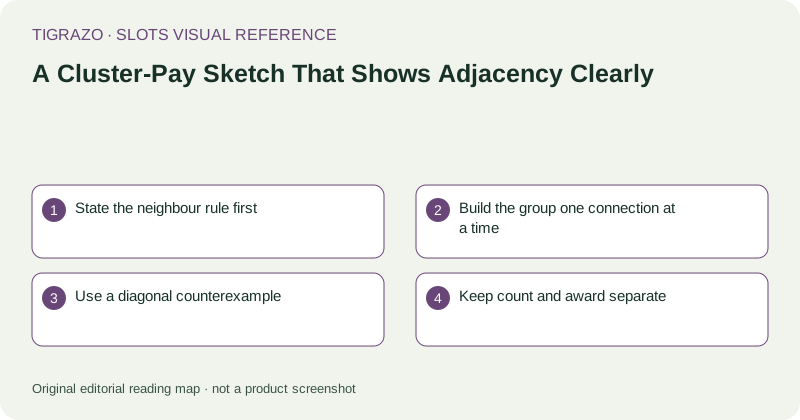
State the neighbour rule first
A common cluster rule uses horizontal and vertical adjacency, but this must be established for the game being explained. Some systems may define connections differently. The schematic should therefore state the allowed relationship rather than treating the word cluster as a complete specification.
Use small connector marks or a verbal coordinate list to show which cells touch under the chosen rule. Keep those marks distinct from any highlight indicating that the group has reached the minimum qualifying count.
Build the group one connection at a time
Start with one matching symbol and trace allowed connections to others of the same kind. Every included position must be connected to the group through permitted neighbours. Symbols need not all touch the starting position directly if a valid chain connects them.
A branching shape can therefore form one cluster. The relevant question is connectivity, not whether the shape resembles a straight line, square or familiar object. This distinction is particularly useful in irregular or partially filled grids.
Use a diagonal counterexample
Hypothetical example: assume only horizontal and vertical neighbours count and five matching symbols are required. Four A symbols form a connected block, while a fifth A touches that block only diagonally. The sketch should show a four-symbol group, not a qualifying five-symbol cluster.
If another A is placed directly above an existing A, the connected group reaches five. That modified example illustrates why position matters. It does not establish how likely either arrangement is during actual play.
Keep count and award separate
After identifying the group, consult the relevant award schedule. A count alone does not determine a currency amount without knowing the symbol, stake basis and any applicable modifier. Different symbol types may have different awards for the same cluster size.
If two separate clusters appear, show them with distinct identifiers. Do not merge them merely because they share a symbol type. Whether separate groups pay independently, combine or interact with a feature must be explained by the rules.
Caption the scope honestly
Describe the sketch as an illustration of adjacency under a stated hypothetical rule. Avoid presenting the arrangement as a screenshot or suggesting that a large connected area predicts a cascade. Later replacements are separate events governed by their own mechanics.
- Are permitted neighbours named?
- Are diagonal contacts handled explicitly?
- Is every counted symbol connected?
- Is the minimum count stated?
- Are group identification and payout calculation separated?
A clear cluster sketch lets a reader reproduce the count independently. If the explanation depends entirely on a coloured blob surrounding symbols, add connection detail so that the boundary is evidence of the stated rule rather than an unexplained editorial assertion.