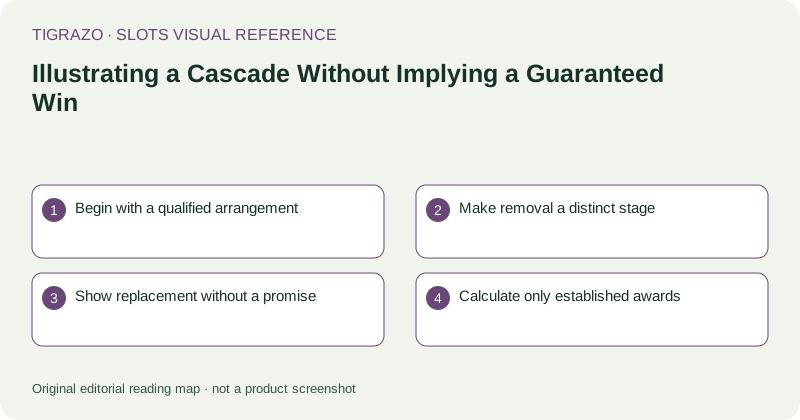
Begin with a qualified arrangement
The opening panel should explain why an award qualifies under the stated matching rule. Highlight the exact symbols involved and label any substitutions or modifiers. Without this foundation, the removal stage can make it seem that arbitrary symbols disappear whenever the grid looks busy.
Describe the arrangement as hypothetical. Its purpose is to teach a sequence, not to document a real round or indicate how often a similar combination occurs.
Make removal a distinct stage
Show which symbols are removed, transformed or retained according to the mechanic. Not every cascade system handles winning positions identically, so the diagram must avoid presenting one treatment as universal. Persistent symbols or special markers need their own labels.
Use a clear before-and-after distinction rather than overlapping every stage on one grid. Overlays can be compact, but they often make readers count symbols that no longer coexist in the same game state.
Show replacement without a promise
The replacement panel should indicate where new symbols appear and how remaining symbols move, if movement is part of the stated mechanism. Arrows describe this movement only. They should not point towards a cash label unless a new award has actually qualified in the example.
Include a branch where replacements produce no qualifying pattern. This is essential visual information, not a pessimistic addition. Without it, a chain of colourful panels can imply that continuation is automatic.
Calculate only established awards
Hypothetical example: an initial stage awards 0.80, a replacement stage awards 0.40, and the next arrangement produces no award. The total is 1.20 before any separately specified modifier. Do not add a potential later prize simply because the illustration has room for another panel.
If a cascade multiplier changes between stages, label each applicable base and multiplier explicitly. A rising counter may modify only particular awards, not the entire historical total. The rule determines which calculation is correct.
End the sequence visibly
The final panel needs a clear stopping label such as no qualifying combination under the stated rule. This identifies the end condition without suggesting that the game almost owes another award. A near match is a spatial observation, not a probability forecast.
- Is the initial award justified?
- Are removal and replacement separate?
- Does at least one branch stop?
- Are stage awards distinguished from the accumulated total?
- Are multiplier bases labelled?
A complete cascade illustration explains a conditional process. It should leave readers understanding how reevaluation works, while making no claim that any next replacement will win or that a previous cascade predicts a future one.