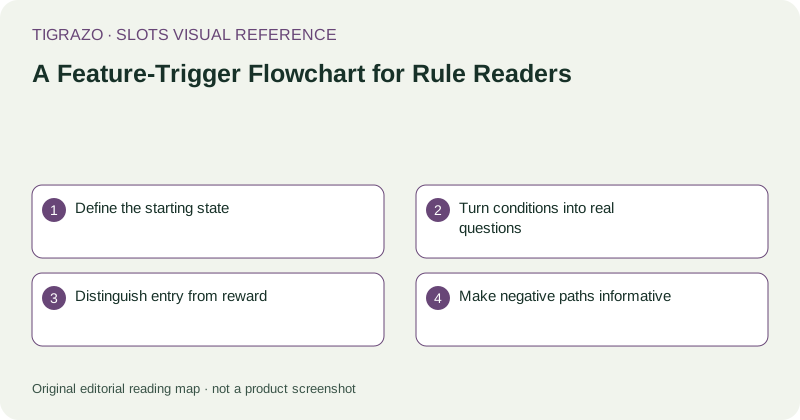
Define the starting state
Begin with a clearly named state such as ordinary paid round under the specified configuration. A feature may have different rules in another mode, so a chart that begins simply with spin can conceal important scope. Include the rule version in the accompanying prose when relevant.
The first question should concern eligibility if eligibility is conditional. A later symbol pattern cannot establish entry when the current mode or setting does not qualify under the rules.
Turn conditions into real questions
Use decision labels that can be answered yes or no. For example, are at least three trigger symbols present in allowed positions? This is clearer than a vague box labelled bonus chance. Each branch should correspond to a documented condition rather than an impression of how exciting the round appears.
Separate combined conditions when doing so improves clarity. A required count and a required reel placement may deserve two decisions, especially if readers commonly overlook one of them.
Distinguish entry from reward
A successful trigger branch should lead to feature entry, not automatically to a positive net result. The feature's internal rules determine its possible awards. If the trigger also pays directly, show that as a separate action with its own calculation basis.
Hypothetical example: three qualifying symbols award entry to six feature actions, while four award entry to eight. The chart can show those two entry counts. It cannot infer that eight actions guarantee a larger final award than six in any particular instance.
Make negative paths informative
A no branch might lead to no feature entry, while still allowing an ordinary base-game award. Avoid labelling every unsuccessful trigger branch loss, because that confuses the feature condition with the round's complete financial result.
Likewise, an ineligible-setting branch should say why the trigger test does not apply. It should not imply that switching to a more expensive setting is necessary or advisable. The chart's task is explanation, not conversion.
Audit the chart against the prose
Trace one qualifying case, one near miss and one ineligible case. At each step, verify that the labels preserve counts, positions and exceptions from the rule. A simplified chart is useful only if its simplification does not change the condition.
- Is the starting mode named?
- Does every decision have clear branches?
- Are probabilities omitted unless genuinely established?
- Does feature entry remain separate from settlement?
- Can an ordinary award exist on a no-entry path?
Finish with a caption explaining that the chart summarises conditional logic. Arrow direction shows reading order, not the passage of a player towards an inevitable bonus.